Understanding Abstractions
A skill I often see underdeveloped in developers is layering simple abstractions. Maintaining this discipline is crucial in dodging code quagmires, which can be deadly when bugs occur. This has always been important, but because genies don’t understand this concept maintaining this quality is becoming central to the value we bring.
To illustrate this concept, I’m going to provide an example from a recent project I’ve been working on. On a Go board, adjacent points in same state are considered connected:
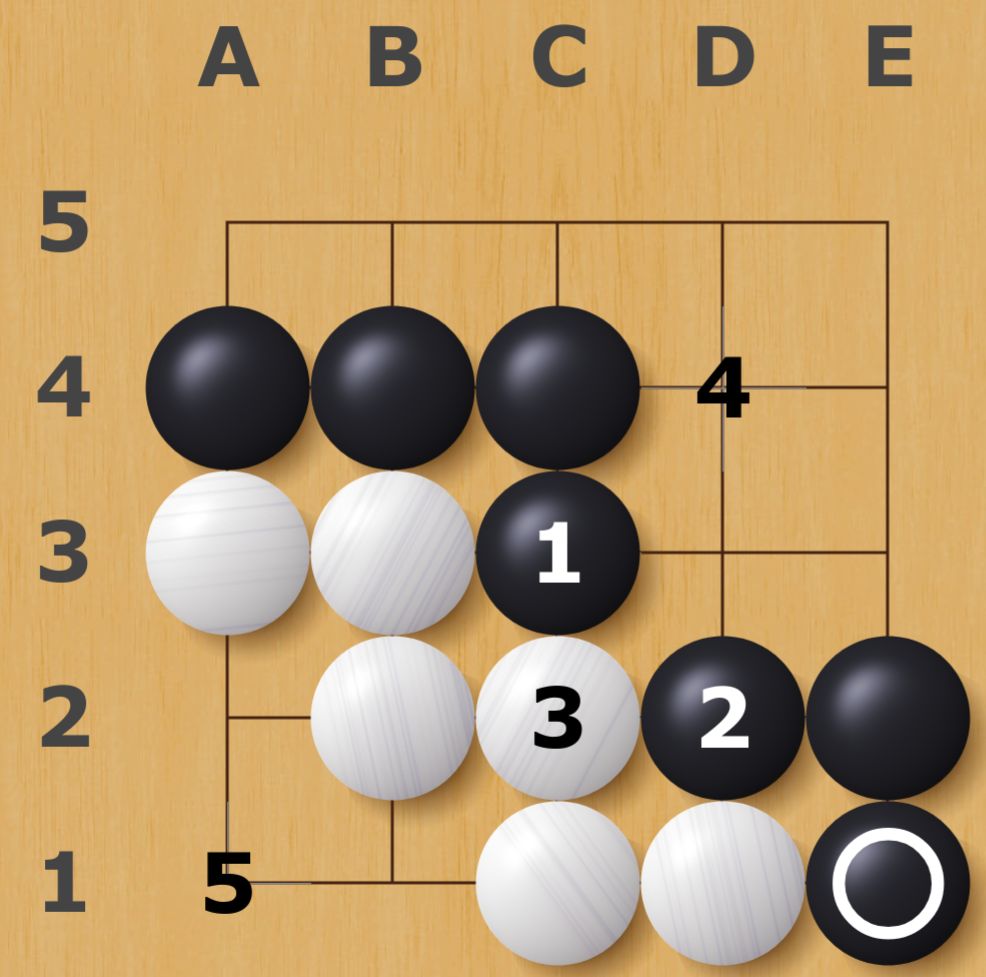
So the groups marked 1, 2 and 3 are each distinct in this regard. I’m also going to refer to 4 and 5 as connected groups, this is useful for the logic I’m developing even though Go players don’t refer to them in this way.
I want to develop a cache of these groups, which can be accessed
efficiently using a javascript Map. As new stones are added and
removed from the board, this will need to be updated accordingly.
Smaller is Better
A point on the board is comprised of x and y coordinates, which feels
natural to represent as [x, y]. It’s tempting to also the state of
that position, but this is the first lesson: the more sprawling the
abstraction the harder it is to reason about it.
To illustrate this point, let me share with you a simple utility function I use in several places in this project:
function neighbors([x, y]: Point): Point[] {
  return [[1, 0], [-1, 0], [0, 1], [0, -1]]
    .map(([ox, oy]) => [x + ox, y + oy])
}
Because it doesn’t need to be aware of the state of the board, it can remain self contained and more generic. If it needs the state, how do we figure out what to include there? One option would be to put some sort of dummy value:
function neighbors([x, y, _]: Point): Point[] {
  return [[1, 0], [-1, 0], [0, 1], [0, -1]]
    .map(([ox, oy]) => [x + ox, y + oy, " "])
}
This would be functional, but adds unnecessary weight to the abstraction. Now, whenever you use the results of this function, you have to keep in mind that the state of that point should be disregarded. Eventually, you’ll accidentally use that state and have a confusing bug to track down when it leaks into other parts of the code.
The other option is to provide enough context to provide meaningful state:
function neighbors([x, y]: Point, board: Board): Point[] {
  return [[1, 0], [-1, 0], [0, 1], [0, -1]]
    .map(([ox, oy]) => {
      const nx = x + ox
      const ny = x + oy
      return [nx, ny, board.get(nx, ny)]
    })
}
Again, this would be functional, but introduces different
problems. To start, when writing the tests for this function, a
Board has to be constructed to provide this state. Next, knowledge
of the state is helpful in some situations but can become a burden in
others, which I’ll come back to when I discuss sets of points.
Grouping Reduces Complexity
Discussing the entire Board class is beyond the scope of this
article, but notice that because Point doesn’t include state we can
have a signature like this: get(point: Point): State | undefined. In the
previous example, because state was part of the type, we had to call a
version that looked like this: get(x: number, y: number): State | undefined.
To understand the consequence of this, consider the situation where you only want neighbors that are valid board positions:
class Board {
  ...
  neighbors(point: Point): Point[] {
    return neighbors(point).filter((n) => this.get(n))
  }
  ...
}
Notice that this function doesn’t need to understand anything about
how Point is structured. If it was aware of state, then to call
get we would have to break into the individual x and y
coordinates. Moreover, it ceases to make sense to decompose the work
into two simple functions.
class Board {
  ...
  neighbors([x, y, _]: Point): Point[] {
    return [[1, 0], [-1, 0], [0, 1], [0, -1]]
      .map(([ox, oy]) => board.get(x + ox, y + oy))
      .filter(n => n)
  }
  ...
}
What you’re witnessing here is how
balls of mud begin to form. The wrong
abstraction was chosen for Point, so logic has begun accumulating
instead of being decomposed. The former version was compact and
bootstrapped from a more general concept, whereas the latter must know
about everything to accomplish its goal.
Also notice how much harder it is to understand the latter version, instead of taking it in at a glance you have to understand the goal of the low level transformations. Genies might be able to determine that rapidly, but it takes more tokens to do so and over an entire codebase this can lead to slower and more expensive development costs.
Unnecessary Weight
Because Javascript’s Set implementation would not work as expected
(the abstraction is
leaky),
I had to develop PointSet to handle these. The implementation is
rather boring, so I won’t share it here, but it’s a class I use all
over the place.
Part of what makes it so useful is that it conforms to the
Single Responsibility Principle.
It has one job and does it well, and I rarely think about how it
accomplishes its goal. Keeping Point to x/y coordinates is the
secret sauce of why I never have to think about it, to understand why
let’s explore what would happen if it included state.
If we include state as part of what makes a point unique, it could be put in a state where the same coordinates can be in two states simultaneously. Even if you never care about the state, it’s still vulnerable to this kind of problem:
const set = new PointSet()
set.add([0, 0, "B"])
set.add([0, 0, "W"])
set.remove([0, 0, "W"])
When remove is called, it’s reasonable to expect that (0, 0) is no
longer in the set. If you iterate over the members, though, you’ll
find that a phantom [0, 0, "B"] is still hanging around.
To address this, we could consider ignoring the state when it comes to uniqueness. As long as you’re the only one to ever interact with the class, it might be feasible to keep that detail in your head. Now that we have genies, though, this is virtually never true. In my experience, this manifests as a hallucination assuming that uniqueness extends to the state. As a result, every interaction with the class grows defensive logic, guarding against the possibility that an existing point exists with a different state.
Both of these options are sub-optimal, and the consequences add weight to interacting with the class. It’s a detail that needs to be tracked, adding to either your mental or the genie’s context. If you try to shed that weight, it results in subtle errors or superfluous code, both of which simply shift the weight into debugging time or the codebase.
Levels of Abstraction
Now we can finally discuss the group cache, which will use a two
tiered Map to provide rapid lookup.
export class GroupCache {
  groups: Groups
  constructor(starting_groups?: Groups) {
    if (starting_groups) this.groups = starting_groups
    else this.groups = new Map()
  }

  at(point: Point): PointSet | undefined {
    return this.get(point)!.points
  }
  ...
}
To add members to this cache, an update function is defined:
update(point: Point, state: State) {
  this.remove_from_existing_group(point, state)
  this.set(point, {
    state,
    points: this.add_to_new_group(point, state),
  })
}
What’s important to understand here is that all of this logic operates
at the same level. No part of at or update looks inside of
point, they delegate to get and set to operate on those:
private get([x, y]: Point): PointGroup | undefined {
  return this.groups.get(x)?.get(y)
}

private set([x, y]: Point, point_group: PointGroup) {
  if (!this.groups.has(x)) this.groups.set(x, new Map())
  this.groups.get(x)!.set(y, point_group)
}
What’s interesting is that, although these operations aren’t complex,
they have some nuance protecting against common errors. For example,
set first ensures that the map exists for x before attempting to
call set on it. None of that matters from the perspective of
update, though, it can focus on what it means to update instead of
having to muck about with data structure massaging.
Genies
As I’ve alluded to a few times, this kind of thinking and design skills are precisely what’s needed when working with coding assistants. My first attempt at creating this cache was done by Codex, which tightly bound the cache to capturing rules from the game. Sometimes that’s good enough, but in this case it fell apart when I started tracking captures for scoring purposes.
When you take care to form clean abstractions, though, these
assistants can really sing. When I was working on
remove_from_existing_group, I needed to break apart a single
PointSet into subsets that were connected. This logic is a bit
hairy, but because the goal had such a clean definition, I was able to
generate that functionality rapidly.
The takeaway isn’t that genies are awful or wonderful, it’s to better understand what they are good and bad at. This article explores that boundary to help you better understand how to navigate it.